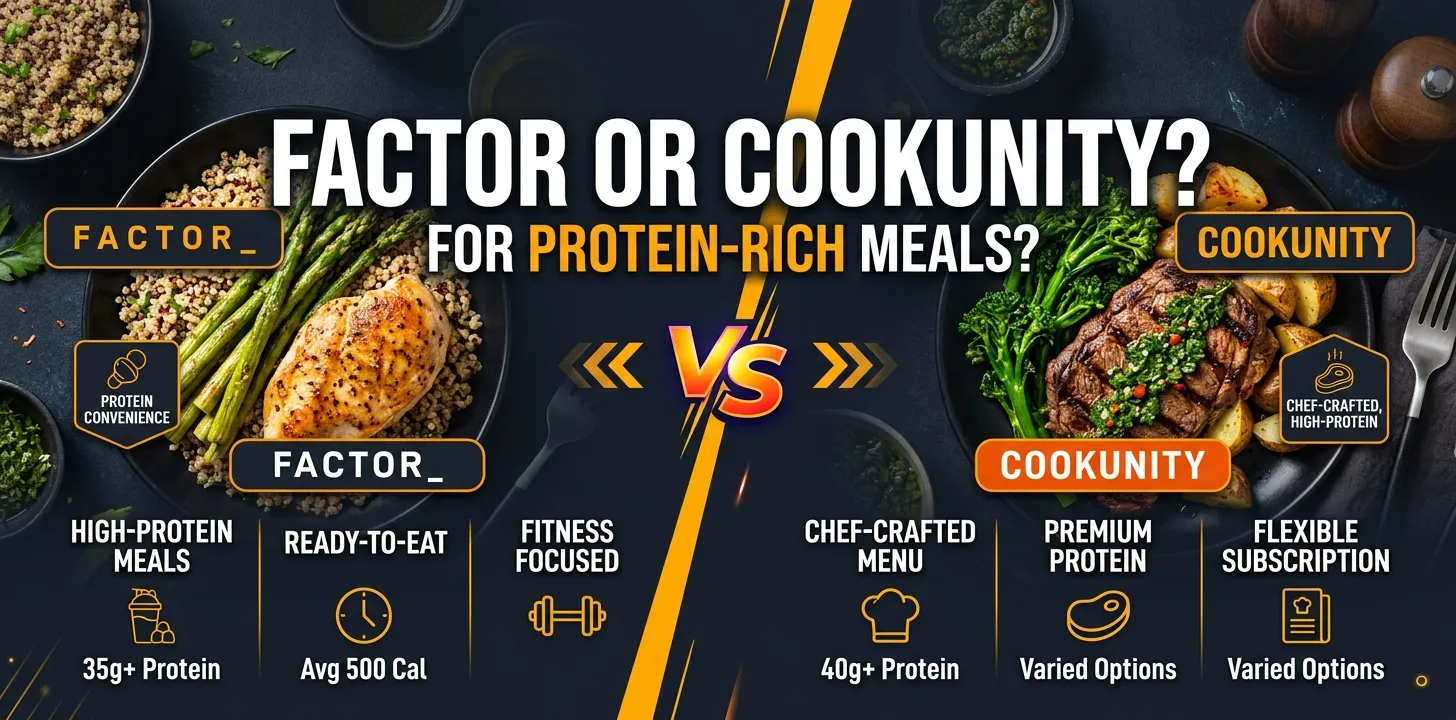
Factor or CookUnity for busy people?
If you are short on time, both Factor and CookUnity can remove most of the work behind weekday meals. Factor is the stronger choice for busy people who want structured nutrition and easy meal planning, while CookUnity is better for people who want more chef-driven variety and a restaurant-style experience. Both offer fully prepared meals that can be heated quickly.
The better choice depends less on how busy you are and more on what you want your meal service to solve.
Factor vs. CookUnity at a Glance
Both services deliver prepared meals, so neither requires the shopping, chopping, or cooking that comes with a traditional meal kit. The main difference is what each service emphasizes.
| Factor | CookUnity |
|---|---|
| Best for structured nutrition | Best for food variety |
| 100+ weekly menu items and add-ons | 300+ rotating meals |
| Dietitian-designed meals | Chef-created meals |
| High Protein, Keto, Calorie Smart, Vegan + Veggie and more | Wide range of cuisines and dietary preferences |
| Meals heat in about 2 minutes | Meals are designed to be ready in about 2 minutes |
| Good fit for routine-focused eaters | Good fit for people who get bored easily |
| Skip, pause, or cancel | Skip, pause, or cancel |
Factor says its current menu includes 100+ dietitian-designed meals and add-ons, while CookUnity says it offers more than 300 rotating dishes and plans ranging from 4 to 16 meals per week.
The simplest way to choose
Think about your biggest weekday problem.
If it is “I don’t have time to think about what fits my eating goals,” Factor makes more sense.
If it is “I don’t have time to cook, but I still want interesting food,” CookUnity may be the better fit.
Why Factor Works Well for Busy People
Factor is built around reducing the number of food decisions you need to make during a busy week.
Its meals arrive prepared. You choose meals from the weekly menu, store them as directed, and heat them when you are ready to eat. Factor says its meals require no preparation and can be heated in about two minutes.
That can be useful for people who have:
- Long workdays
- Busy school or work schedules
- Little interest in meal prep
- Specific nutrition preferences
- A hard time planning meals ahead
- A need for quick lunches or dinners
Factor also separates meals into preferences such as High Protein, Calorie Smart, Keto, Vegan + Veggie, and Chef’s Choice. That makes it easier to start with a general eating preference instead of browsing every meal without a plan.
Factor is especially useful when nutrition is part of the problem
A busy schedule often leads to random food choices. You may grab takeout because it is faster than deciding what to cook.
Factor can reduce that decision burden.
For example, a hypothetical remote worker might have meetings from 9 a.m. to 5 p.m. Instead of planning lunch during the workday, they could have a prepared meal in the refrigerator and heat it when they get a break.
The convenience is not just the two-minute heating time. It is also not having to plan the meal from scratch.
Why CookUnity Works Well for Busy People
CookUnity takes a different approach.
Its meals are created by professional chefs, and the company says customers can choose from more than 300 rotating dishes. Plans currently range from 4 to 16 meals per week.
That makes CookUnity appealing if your main goal is to avoid cooking without eating the same type of food all week.
You can choose different meals rather than building your week around one limited menu style.
CookUnity also lets customers skip, pause, or change their plan, which can help if your schedule changes from week to week.
CookUnity may be better for people who get bored with routine meals
Imagine a hypothetical consultant who spends several nights a week working late.
They do not want to cook at 8:30 p.m. But they also do not want another basic meal every night.
For that type of routine, CookUnity’s chef-focused menu and large rotating selection may be more appealing than choosing meals primarily around a nutrition plan.
Which Is Faster for a Busy Schedule?
Both are designed to save time because the meals arrive already prepared.
Factor says its meals can be ready to eat in about two minutes. CookUnity also advertises meals that are ready in about two minutes.
So heating time alone is not a strong reason to choose one over the other.
The bigger time-saving difference is meal selection.
Factor can make decisions easier if you already know that you want something like high-protein or calorie-conscious meals.
CookUnity can save time if you simply want to pick several meals you like from a broad chef-created menu.
Factor vs. CookUnity for Weekly Meal Planning
A useful way to compare them is to look at what happens before dinner.
With Factor:
- Choose your meal preference.
- Select meals from the menu.
- Receive the prepared meals.
- Refrigerate them.
- Heat one when needed.
Factor says customers can change meal quantities and preferences, skip weeks, pause, or cancel.
With CookUnity:
- Choose a weekly meal plan.
- Select your meals.
- Receive the prepared meals.
- Refrigerate them.
- Heat and plate the meal.
CookUnity says customers can choose between 4 and 16 meals per week and can skip, pause, or change their plan.
For a very unpredictable schedule, that flexibility matters more than small differences in preparation time.
Which Has More Food Variety?
CookUnity has the edge if variety is your main concern.
CookUnity currently promotes 300+ rotating meals and a chef-driven marketplace. Factor promotes 100+ weekly meals and add-ons.
That does not automatically mean CookUnity will have more meals you personally like.
A person who wants high-protein, keto, or calorie-focused choices may find Factor’s menu structure easier to use.
Someone who wants to explore different cuisines may prefer CookUnity’s approach.
Which Is Better for Specific Eating Preferences?
Factor has a clear advantage when your busy schedule is tied to a specific nutrition goal.
Its current meal options include:
- High Protein
- Keto
- Calorie Smart
- Vegan + Veggie
- Chef’s Choice
- Other dietary-focused choices
Factor also provides ingredient, nutrition, and allergen information for its meals.
CookUnity also offers dietary filters and preferences, but its core selling point is more about chef-created variety than a tightly structured nutrition system.
If you have a medically required diet or a serious food allergy, do not assume a meal-service label alone makes a meal safe. Check the current ingredient and allergen information for the exact meal before ordering.
What About Price?
Price can change based on the number of meals, promotions, delivery location, and plan.
CookUnity currently lists meals starting at $12.59 per meal, with delivery generally adding a flat $9.99 or $11.99 fee depending on ZIP code, according to its pricing page.
Factor’s current promotions can reduce the first-box price substantially, but its published offer also says shipping fees apply and that discounts do not necessarily apply to every upgrade or add-on.
That means you should compare the final weekly checkout total, not just the advertised introductory price.
Introductory offers can make either service look much cheaper during the first few deliveries than it will be later.
Which Is Better for a Single Busy Person?
Both can work well for one person.
Factor specifically offers meal delivery for one and says its meals arrive ready to heat and eat.
CookUnity also lets customers choose individual meals and select plans from 4 to 16 meals per week.
For one busy person, the best choice often comes down to this:
Choose Factor if you want your weekly food routine to be predictable and nutrition-focused.
Choose CookUnity if you want your meals to feel more varied and chef-driven.
What Busy People Should Check Before Ordering
Convenience is valuable, but there are a few details worth checking first.
Check the delivery schedule
A prepared meal service only saves time if the delivery works with your routine.
Make sure you have a practical place to receive and refrigerate the meals.
Look beyond the introductory discount
A large first-order discount is useful, but it should not decide the entire purchase.
Calculate what you would pay at the regular price after the promotion ends.
Check the weekly cutoff
Factor says customers need to skip a delivery before its stated cutoff to stop the following week’s order.
This matters if your schedule changes often.
Look at actual meals, not just plan names
A plan can sound perfect until you look at the meals available in your area.
Before ordering, check several upcoming dishes and see whether you would realistically eat them.
Factor or CookUnity for Busy People: The Final Choice
Factor is the better fit for busy people who want structure, nutrition-focused choices, and a simple weekly routine. CookUnity is the better fit for busy people who care more about chef-created variety and enjoying different types of food without cooking.
If you are unsure, do not choose based only on the promotional price. Look at the current menus, compare the meals you would actually eat, and calculate the regular weekly cost after discounts end.
The practical tip is simple: choose the service that removes your biggest food problem. If decision-making and nutrition are the problem, start with Factor. If cooking and meal boredom are the problem, CookUnity is likely the more natural fit.
Frequently Asked Questions
Is Factor or CookUnity better for a busy work schedule?
Both are designed for people who want prepared meals without cooking from scratch. Factor has a stronger focus on structured meal preferences, while CookUnity emphasizes chef-created variety.
Which is better if I do not want to cook at all?
Both can work because the meals arrive prepared and only need heating. Factor says its meals take about two minutes to heat, while CookUnity also advertises meals ready in about two minutes.
Is CookUnity cheaper than Factor for busy people?
There is no single answer because the final cost depends on your meal quantity, delivery fee, promotions, and selected meals. CookUnity currently lists meals starting at $12.59, while Factor’s promotions and regular pricing can vary, so compare the final checkout price for the plan you actually want.