Factor or CookUnity for convenient dinners?
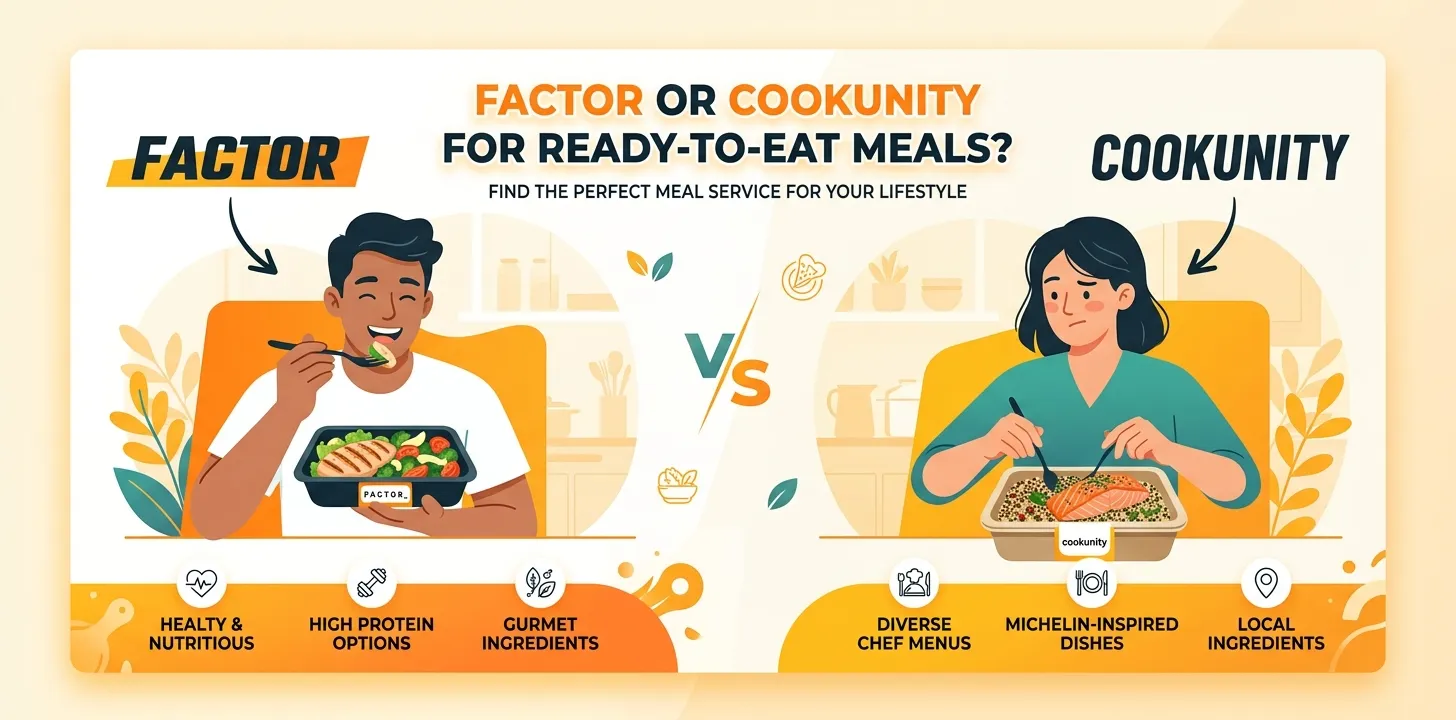
If your main goal is to make weeknight dinner easier, both Factor and CookUnity are strong choices because the meals arrive fully prepared and chilled. You choose your meals, store them in the refrigerator, and heat them when you are ready to eat. Factor is the better fit for structured nutrition, while CookUnity has an edge for people who want more chef-driven variety and restaurant-style choices.
The real question is not which service is universally better. It is which one removes the most work from your particular dinner routine.
For someone who gets home late, does not want to grocery shop, and wants dinner ready in a few minutes, both services solve the same basic problem. But they take different approaches to the food itself.
Factor vs. CookUnity for Dinner Convenience
| Factor | CookUnity |
|---|---|
| Fully prepared meals | Fully prepared meals |
| Chilled, fresh meals | Chilled, fresh meals |
| About 2 minutes to heat | About 2 minutes to heat |
| 100+ weekly meal options advertised | 300+ weekly meals advertised |
| Strong focus on nutrition and diet plans | Strong focus on chef-created variety |
| Options for high protein, keto, vegan, vegetarian and more | Options including vegetarian, vegan, keto, pescatarian and more |
| 4–18 meal plans may be available depending on current plan options | 4–16 meals per week |
| Weekly menu selection | Weekly menu selection |
| Skip, pause, or cancel | Skip, pause, or cancel |
Factor currently promotes more than 100 weekly meal and add-on options, while CookUnity advertises more than 300 weekly meals. Both services emphasize meals that can be heated in about two minutes.
That difference matters if you are trying to avoid dinner boredom. CookUnity gives you a wider chef and cuisine selection, while Factor makes it easier to shop around specific nutrition preferences.
Which Is More Convenient for Busy Weeknights?
For pure convenience, there is very little difference in the basic routine:
- Choose your meals online.
- Receive the meals chilled.
- Put them in the refrigerator.
- Heat one when you are hungry.
- Eat without grocery shopping, chopping, cooking, or cleaning a pile of pans.
Factor describes its meals as ready to heat and eat in about two minutes. CookUnity also says its meals are ready in about two minutes and arrive fresh and chilled.
The bigger difference comes before and after heating.
Factor makes nutrition planning easier
Factor is useful if convenience means more than saving cooking time. Its menu is built around diet and nutrition preferences, with choices such as high protein, keto, Calorie Smart, vegan, vegetarian, and other plans. Factor also provides nutrition information for its meals before you order.
That can save time for someone who normally spends part of Sunday planning meals around calories, protein, carbs, or dietary preferences.
CookUnity takes a chef-centered approach. Its current service promotes hundreds of meals, professional chefs, different cuisines, and filters for dietary needs. You can pick individual meals each week instead of building dinner around one fixed menu.
This is especially convenient if your biggest problem is decision fatigue at the end of a long workday. You can keep several different meals in the refrigerator and choose based on what sounds good that night.
Factor or CookUnity: Which Has Better Meal Variety?
If variety is your top priority, CookUnity has the stronger case.
CookUnity currently advertises more than 300 rotating meals and says its platform works with 100 professional chefs. Its menu covers many cuisines and dietary preferences.
Factor is no slouch. It advertises 100+ rotating weekly options and allows customers to mix different meal preferences rather than being locked into just one category.
The difference is how the variety is organized.
Choose Factor if you think:
“I want several convenient meals that fit the way I already eat.”
Choose CookUnity if you think:
“I want several different meals because I get bored eating the same kind of food.”
For example, a busy professional who wants high-protein dinners throughout the week may find Factor easier to shop. Someone who wants Thai food one night, Italian-inspired food another night, and a different chef’s dish later in the week may prefer CookUnity.
Which Is Better for Nutrition-Focused Dinners?
Factor has the clearer advantage if nutrition is part of your definition of convenience.
Factor offers meal categories designed around different eating preferences and goals, including high-protein, keto, lower-calorie, vegan, and vegetarian options. The company says its meals are approved by dietitians and provides nutrition details for individual recipes.
CookUnity also has useful dietary filters. Its current menu includes options such as vegan, vegetarian, Mediterranean, keto, pescatarian, gluten-free, low-calorie, low-carb, and dairy-free meals.
So CookUnity is not a poor choice for nutrition-conscious eaters. The distinction is that Factor puts nutrition structure closer to the center of the shopping experience, while CookUnity puts more emphasis on chef selection and food variety.
If you have a medical condition or a medically prescribed diet, do not assume that a meal-service label alone makes a meal appropriate for you. Check the complete ingredient and nutrition information and follow advice from your healthcare professional when needed.
What About Freshness and Refrigerator Storage?
Both services use chilled meals rather than requiring you to cook from raw ingredients.
Factor says its meals arrive fresh and never frozen, and some current Factor information says meals can stay fresh in the refrigerator for up to seven days.
CookUnity says its meals are fresh and chilled, not frozen, with a refrigerated shelf life of about three to seven days depending on the meal. Each meal has an “Enjoy Before” date.
That creates one important convenience rule: check the dates when your box arrives.
Do not assume every meal will last the same number of days. If you order enough dinners for the whole week, plan to eat the meals with the earliest dates first.
If you will not eat a CookUnity meal before its date, CookUnity says you can freeze it beforehand and thaw it in the refrigerator before heating.
Which Costs Less for Convenient Dinners?
Pricing changes with the number of meals, promotions, location, and plan details, so the advertised introductory price is not the best way to compare the two.
CookUnity currently lists meals starting at $12.59 and says delivery is a flat $9.99 or $11.99 depending on ZIP code. The service also offers larger weekly plans, with the per-meal price changing as the meal count changes.
Factor’s current promotions can reduce the first-box cost, but its terms also state that shipping fees apply to deliveries and that promotional pricing does not necessarily apply to upgrades, add-ons, taxes, or shipping. One current Factor offer advertises 50% off the first box for qualifying new customers.
For a fair comparison, look at the final checkout total, not just the headline discount.
Your real cost is:
Meals + shipping + applicable taxes/add-ons − valid discounts
That number is more useful than comparing each company’s advertised starting price.
Which Is Better for a Single Person?
Both can work well for one person because the meals are designed as individual prepared portions.
Factor specifically promotes meal delivery for one person and offers several diet-focused options within that service.
CookUnity says its standard meal is generally intended to serve one person and lets customers choose between 4 and 16 meals per week.
For a single adult who only wants help with dinner, the important question is how many meals you will actually eat.
Ordering too many meals can reduce the convenience if your refrigerator becomes crowded or you struggle to finish everything before the use-by dates.
A practical approach is to start with enough dinners to cover the nights when you are normally too busy to cook. You do not need to replace every meal at home just to benefit from a prepared-meal service.
Which One Should You Choose?
The easiest way to decide is to match the service to the reason you want convenient dinners.
Choose Factor if you:
- Care strongly about protein, calories, carbs, or other nutrition details.
- Want diet-focused meal categories.
- Prefer a more structured meal-selection process.
- Want prepared dinners without spending time on meal prep.
- Like having nutrition information available before ordering.
Choose CookUnity if you:
- Want a large selection of chef-created meals.
- Get bored with repetitive dinners.
- Like trying different cuisines.
- Want the experience to feel closer to ordering a prepared restaurant-style meal.
- Prefer choosing individual dishes from a large rotating menu.
A simple real-world example
Imagine you work from home and finish work at 6:30 p.m. Your main problem is not nutrition planning. You simply do not want to cook.
CookUnity may be the better fit because you can keep several different meals ready in the refrigerator and choose one based on your mood.
Now imagine you work out several days a week and already know that you want higher-protein meals with specific nutrition information.
Factor may save you more mental effort because its meal categories and nutrition-focused shopping tools fit that routine more closely.
The Convenience Factor People Often Miss
The biggest benefit of either service is not the two-minute heating time.
It is the work you do not have to do.
A prepared dinner can replace several separate tasks:
- Deciding what to make
- Writing a grocery list
- Driving to the store
- Buying ingredients
- Washing and cutting food
- Cooking
- Cleaning cookware
- Figuring out what to do with leftovers
That is why the value of Factor or CookUnity depends on your schedule as much as the price of the food.
If you already enjoy grocery shopping and cooking, a prepared meal may not feel worth the premium. If dinner is the part of your day where everything becomes rushed, eliminating those steps can be much more valuable.
The Bottom Line
For convenient dinners, both Factor and CookUnity are good choices because neither requires traditional meal prep. Factor is the better pick for nutrition-focused convenience, while CookUnity is the better pick for maximum meal variety and chef-driven choices.
If you are unsure, compare the current menus for the exact week you plan to order. Look at five things: meals you genuinely want to eat, nutrition information, portion size, delivery cost, and use-by dates. That quick check is more useful than choosing based on a first-box discount alone.
Frequently Asked Questions
Is Factor or CookUnity better for quick dinners?
Both are designed for fast preparation, with current company information stating that meals can be heated in about two minutes. Factor has a stronger nutrition-focused structure, while CookUnity offers a broader chef-created menu.
Can I choose my own meals with Factor and CookUnity?
Yes. Factor lets customers choose meals from its weekly menu, while CookUnity lets customers select individual dishes from its rotating menu. Both also allow customers to adjust their plans rather than being locked into one permanent set of meals.
Which is better if I hate cooking but still want variety?
CookUnity is likely the better fit if variety is your main concern. Its current service advertises hundreds of rotating meals and a large group of professional chefs, giving you more ways to change your dinner routine from week to week.