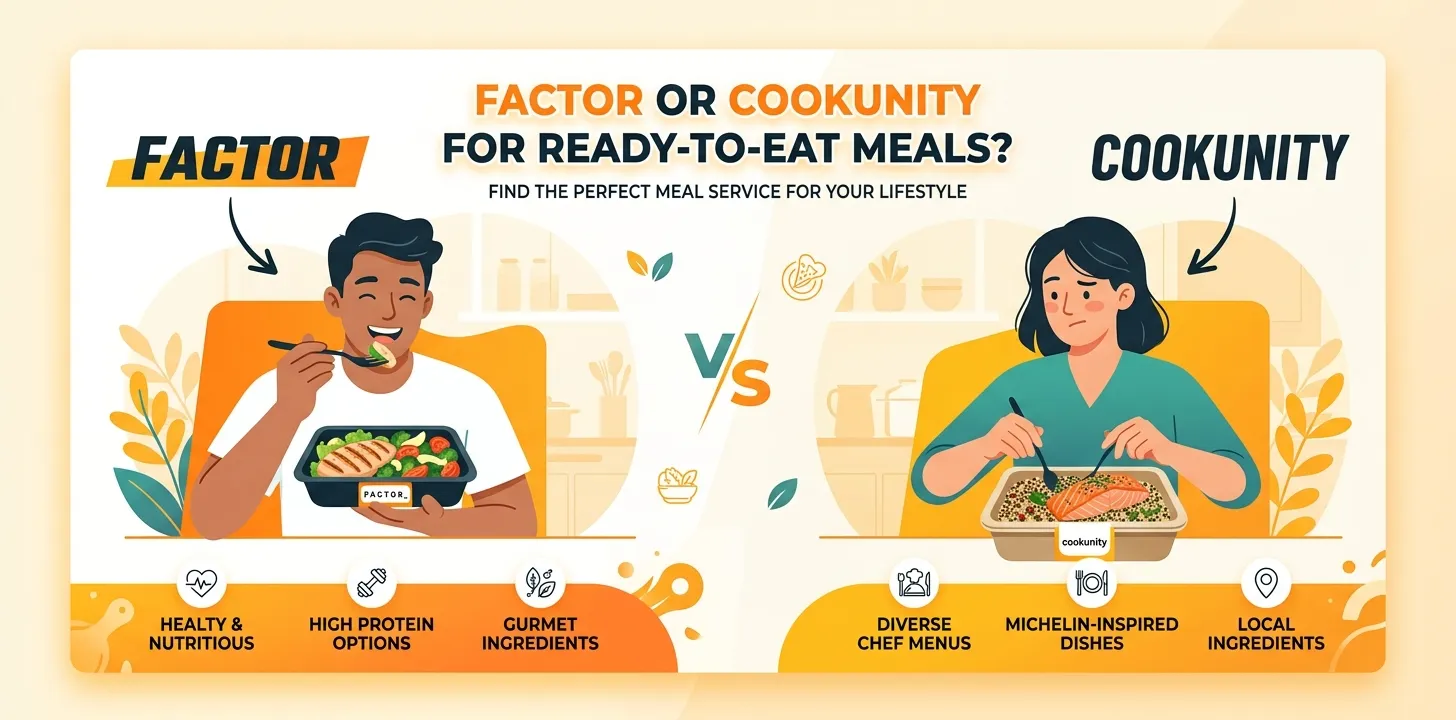
Factor or CookUnity for ready-to-eat meals?
If you want ready-to-eat meals with little or no cooking, both Factor and CookUnity are strong options, but they serve different needs. Factor puts more emphasis on nutrition plans, calories, protein, and structured eating. CookUnity focuses more on chef-created meals, cuisine variety, and restaurant-style flavors. For most people who care most about variety and taste, CookUnity has the edge; Factor is better for nutrition-focused meal planning.
The key question is not simply which service is better. It is which type of prepared meal fits the way you actually eat.
Factor vs. CookUnity at a glance
| Category | Factor | CookUnity |
|---|---|---|
| Meal type | Fully prepared, ready to heat | Fully prepared, chef-crafted |
| Main focus | Nutrition and convenience | Taste and variety |
| Menu style | Rotating prepared meals | Large rotating chef-created menu |
| Meal plans | Nutrition-focused options and preferences | Flexible meal quantities and food preferences |
| Meal quantity | Multiple weekly plan sizes | 4, 6, 8, 12, or 16 meals per week |
| Best for | Protein, calories, structured eating | Variety, cuisines, chef-style meals |
| Cooking required | No | No |
| Typical preparation | Heat and eat | Heat and plate |
| Delivery | Refrigerated prepared meals | Fresh, refrigerated prepared meals |
| Biggest advantage | Nutrition information and structured choices | Large selection and chef variety |
CookUnity currently says customers can choose between 4 and 16 meals per week and select from a menu that can reach 400+ meals. Factor’s current menu includes prepared meals labeled for preferences such as Calorie Smart and Protein Plus.
What makes Factor different?
Factor is built around the idea that you can have a complete meal without shopping, chopping, cooking, or cleaning up a full kitchen.
Its meals arrive prepared and refrigerated. You select meals based on your preferences, keep them cold, and heat them when you are ready to eat.
One of Factor’s biggest strengths is the amount of nutrition information available for individual meals. For example, a current Factor shredded beef bowl lists calories, fat, carbohydrates, fiber, protein, and sodium for the serving.
That can make Factor easier to use if you care about what is in each meal rather than simply choosing whatever sounds good.
Factor is a better fit for nutrition-focused eaters
Factor makes sense if your meal decisions often start with questions such as:
- How much protein does this meal have?
- How many calories does it contain?
- Does it fit my eating preferences?
- Can I get a prepared meal without cooking?
- Can I quickly see the nutrition facts?
Its current menu includes meals that can fit preferences such as Calorie Smart, Protein Plus, Carb Conscious, and other dietary categories.
This does not mean every Factor meal is automatically healthier than every CookUnity meal. A prepared meal still needs to be judged by its ingredients, nutrition facts, portion size, and your own dietary needs.
Factor’s meals are more standardized
Another advantage is consistency.
Factor controls the menu and nutrition information across its prepared meals. That makes the service feel more predictable when you are ordering several meals for the week.
The trade-off is that the experience can feel more like a convenient nutrition service than ordering from a collection of different restaurants.
What makes CookUnity different?
CookUnity takes a more chef-centered approach.
The company says it works with 100 professional chefs and offers up to 400+ meals across its rotating menu. Customers can choose individual meals rather than receiving a random box.
That difference matters if you get bored eating similar meals every week.
Instead of thinking mainly about calories or protein, you can browse meals based on cuisines, flavors, ingredients, and chefs.
CookUnity is stronger for variety
CookUnity is the more appealing option if you want meals such as different international cuisines, creative combinations, and dishes that feel closer to restaurant food.
That chef-driven approach is also one reason recent independent reviews have highlighted CookUnity’s variety and restaurant-style appeal.
The downside is that more choice can also mean more time spent deciding what to order.
You may love having hundreds of options. Or you may prefer Factor’s more structured approach.
Which tastes better: Factor or CookUnity?
If taste and variety are your top priorities, CookUnity is generally the stronger choice.
Its model is centered on professional chefs and a large rotating menu. That gives it more room for different cooking styles, cuisines, sauces, and flavor combinations. Recent testing from WIRED also praised CookUnity for meals that feel closer to real restaurant cooking.
Factor can still be very good. Its current menu includes dishes such as chicken tikka masala, Hawaiian-style chicken, Asian chili shrimp, and Mexican-inspired bowls.
The practical difference is this:
Choose Factor when the nutrition profile matters first. Choose CookUnity when you want dinner to feel more exciting.
Neither service guarantees that every meal will be a favorite. Taste is personal, and prepared meals can also change texture after reheating.
Which has better meal variety?
CookUnity wins for overall variety.
Its current website promotes up to 400+ meals and 100 professional chefs.
That makes it particularly useful for someone who dislikes eating the same type of food repeatedly.
Factor also has a rotating menu, so you are not limited to a tiny group of dishes. Its current meals cover several cuisines and include different nutrition-focused categories.
Still, the two services approach variety differently:
- Factor: variety within a nutrition-focused prepared-meal system.
- CookUnity: variety through different chefs, cuisines, and recipes.
If you want the largest range of flavors, CookUnity is the easier pick.
Which is better for protein and calorie tracking?
Factor has the clearer advantage.
Its meal pages provide detailed nutrition information, and its menu uses categories such as Protein Plus and Calorie Smart.
For example, a current Factor green chile chicken meal lists 480 calories and 43 grams of protein per serving.
That makes it easier to compare meals when nutrition numbers are a major part of your decision.
CookUnity also provides nutrition information and dietary filters, so it is not a poor choice for someone who wants to pay attention to nutrition. The difference is that nutrition is less central to its identity than the chef and menu experience.
If you have a medical condition or need a medically prescribed diet, do not assume either service is appropriate just because a meal carries a dietary label. Check the complete ingredient and nutrition information and follow advice from your healthcare professional.
Which is easier for a busy week?
Both are extremely convenient because neither requires you to cook a meal from raw ingredients.
Imagine two common situations.
Scenario 1: You work late several nights a week.
You want to open the refrigerator, grab dinner, heat it, and move on with your evening. Either service can work well.
Scenario 2: You work late but get bored easily with repetitive food.
CookUnity may be more satisfying because its chef-driven menu gives you more choices from week to week.
So convenience is basically a tie. The difference is what kind of convenience you want: predictable nutrition with Factor or more food choice with CookUnity.
How much do Factor and CookUnity cost?
Prices can change based on the number of meals, delivery location, promotions, and selected meals, so it is better to compare the regular checkout price rather than an introductory offer.
CookUnity currently lists meal plans from 4 to 16 meals per week, with pricing starting at $12.59 per meal on its website. It also states that delivery is a flat $9.99 or $11.99 depending on ZIP code.
Recent 2026 pricing reports place Factor’s standard meal prices roughly in the low-to-mid teens, with the per-meal price generally dropping as you order more meals. Shipping can add a separate charge depending on the current plan and location.
The important point is that the cheapest advertised meal price is not necessarily your final weekly cost.
Before subscribing, check:
- Price per meal
- Number of meals
- Shipping
- Premium meal charges
- Add-ons
- Introductory discount
- Regular price after the promotion
A large first-order discount can make either service look much cheaper than it will be later.
Which is better for special diets?
This depends on what you mean by “special diet.”
Factor has a more structured approach to dietary preferences. Its current menu includes categories such as Protein Plus, Calorie Smart, Carb Conscious, and other food preferences.
CookUnity also lets customers choose from meals with different dietary characteristics. Its large chef network can be helpful when you want more choices, but the availability of a specific dietary option can vary by weekly menu and meal.
For either service, read the actual ingredient list if you have a food allergy or need to avoid a specific ingredient. A general dietary tag should not replace checking the meal’s ingredients and allergen information.
Which service is better for one person?
Both work well for a single person because the meals are individually portioned.
Factor may be better for one person who wants structure. You can build your week around meals that fit your preferred nutrition categories.
CookUnity may be better for one person who wants choice. You can pick different meals instead of cooking several portions of the same dish.
This is especially useful for someone living alone who does not want leftovers sitting in the refrigerator for several days.
Factor vs. CookUnity: the better choice by need
| If your main goal is… | Better choice |
| More chef-created variety | CookUnity |
| Restaurant-style meal experience | CookUnity |
| More cuisine choices | CookUnity |
| Clear nutrition-focused categories | Factor |
| Protein-focused meal selection | Factor |
| Calorie-focused meal selection | Factor |
| Simple ready-to-heat dinners | Either |
| Avoiding cooking | Either |
| Trying different meals every week | CookUnity |
| A more structured meal routine | Factor |
When Factor is the smarter pick
Factor is the better choice if your biggest problem is making convenient meals fit your nutrition goals.
It can be especially useful when you want:
- Prepared meals with detailed nutrition information
- Protein-focused options
- Calorie-conscious choices
- Less meal-planning work
- A predictable weekly routine
- Food that requires very little preparation
Factor’s current menu shows that nutrition categories are built directly into the meal-selection experience.
When CookUnity is the smarter pick
CookUnity makes more sense if your biggest problem is getting tired of ordinary prepared meals.
Choose it when you care most about:
- A large selection of meals
- Different cuisines
- Professional chefs
- Restaurant-style flavors
- Changing your meals frequently
- Choosing individual dishes each week
CookUnity’s current plan structure lets customers choose between 4 and 16 meals per week and change or skip deliveries.
What should you choose?
For the exact question “Factor or CookUnity for ready-to-eat meals?”, I would choose CookUnity for most people who simply want convenient, good-tasting prepared meals.
Its chef-driven model and large menu make it a better fit for people who want variety and do not want their weekly meals to feel repetitive.
I would choose Factor instead when nutrition structure is the main reason you are ordering prepared meals. Its nutrition-focused categories and detailed meal information make it easier to compare meals around calories, protein, and other nutrition targets.
The best choice may also change over time. Someone might prefer Factor during a period when nutrition tracking is the priority, then switch to CookUnity when menu variety becomes more important.
Frequently asked questions
Is Factor or CookUnity better for ready-to-eat meals?
CookUnity is the stronger overall choice if your priorities are flavor, chef-created recipes, and variety. Factor is better if you care more about structured nutrition choices, such as calorie or protein-focused meals.
Are Factor and CookUnity meals already cooked?
Yes. Both services are designed around prepared meals that you heat before eating rather than meal kits that require you to cook from raw ingredients. Factor’s current meals are listed as ready-to-eat, while CookUnity describes its meals as chef-crafted and ready to heat.
Is CookUnity cheaper than Factor?
Neither is always cheaper because the final price depends on the number of meals, shipping, promotions, and other charges. CookUnity currently lists plans from 4 to 16 meals and a starting meal price of $12.59, while current Factor pricing varies by order size. Check the final checkout total before comparing the two.
The bottom line
CookUnity is the better fit if you want ready-to-eat meals that emphasize chef-created variety and interesting flavors. Factor is the better fit if you want convenience plus a stronger focus on nutrition categories and meal-by-meal nutrition information.
Before signing up, compare one full week at the regular price—not just the introductory deal. Pick the service whose meals you would actually want to eat several times a week. That is usually more valuable than saving a few dollars on the first box.