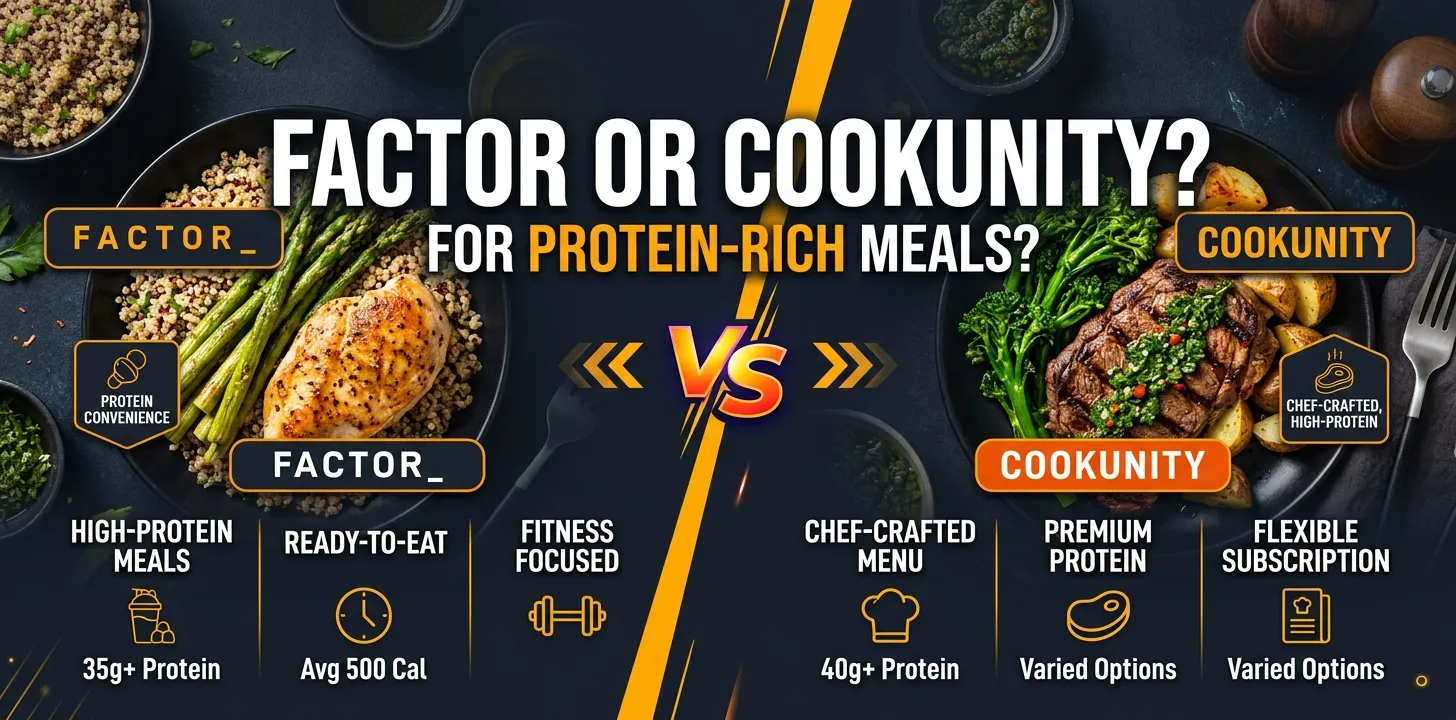
Factor or CookUnity for busy professionals?
When workdays are packed with meetings, deadlines, commuting, and errands, cooking can become one more task on the list. That is where prepared meal delivery can help. Factor and CookUnity both offer ready-to-heat meals, but they take different approaches.
For busy professionals, Factor is usually the better fit if nutrition targets, fast meals, and predictable choices matter most. CookUnity is a stronger choice if you care more about chef-created food, menu variety, and a restaurant-style meal without cooking.
Factor vs. CookUnity at a Glance
The biggest difference is not simply price or cooking time. It is how each service helps you decide what to eat.
| Category | Factor | CookUnity |
|---|---|---|
| Best for | Structured nutrition and busy routines | Variety and chef-created meals |
| Meal style | Chef-prepared, dietitian-approved | Chef-crafted meals |
| Cooking | Heat and eat | Heat and eat |
| Weekly plans | 6, 8, 10, 12, 14, or 18 meals | 4, 6, 8, 12, or 16 meals |
| Menu approach | Nutrition-focused meal preferences | Large chef-driven selection |
| High-protein choices | Strong focus | Available |
| Keto options | Available | Available |
| Vegan/vegetarian | Available | Available |
| Menu variety | Broad | Especially broad |
| Schedule flexibility | Skip, pause, adjust, or cancel | Skip, pause, adjust, or cancel |
| Best match for | Professionals who want less food planning | Professionals who want more food choice |
Factor says its meals are ready to heat and eat in about two minutes and offers meal preferences such as High Protein, Calorie Smart, Keto, Chef’s Choice, and Vegan + Veggie.
CookUnity lets customers select between 4 and 16 meals per week and choose individual meals from a rotating chef-created menu.
Which Is Better for Busy Professionals?
For a professional who wants a dependable weekday meal with very little thought, Factor has the edge.
Its biggest advantage is structure. You can choose meals around preferences such as high protein, calorie-conscious eating, keto, or plant-based meals. That can reduce the amount of time you spend checking every meal from scratch. Factor also lets customers change meal quantities, skip deliveries, pause, or cancel.
CookUnity may be better if your main problem is food boredom. Its model puts more emphasis on chef-created meals and variety. CookUnity says its catalog can include more than 400 meals and about 100 professional chefs, although the exact selection can change.
So the simple choice is:
- Choose Factor when your priority is routine, nutrition preferences, and quick weekday meals.
- Choose CookUnity when your priority is variety, different cuisines, and a more restaurant-like experience.
Why Factor Works Well for a Busy Workweek
A busy professional does not always need the most exciting meal service. Sometimes the best service is the one that removes decisions.
Factor is built around that idea.
Its current service offers more than 100 dietitian-designed meals and additional items such as breakfast foods, shakes, snacks, and other add-ons.
Less meal planning
You do not have to decide what to buy at the grocery store, search for recipes, measure ingredients, or spend time cooking after work.
You still need to choose your weekly meals, but much of the work happens before the food reaches your refrigerator.
Stronger nutrition structure
Factor offers specific meal categories for people who want to pay attention to protein, calories, carbohydrates, or eating patterns.
For example, its current menu includes:
- High Protein meals
- Calorie Smart meals
- Keto meals
- Chef’s Choice meals
- Vegan + Veggie meals
Factor lists some High Protein meals at 50g or more of protein and describes its Calorie Smart meals as about 550 calories or less.
That does not mean every professional needs to track calories or protein. It simply makes Factor useful for people who already have specific nutrition goals.
Good for irregular workdays
Factor allows customers to order different quantities, from 6 through 18 meals per week, and says plans can be adjusted, skipped, or canceled.
That matters if your schedule changes often.
A consultant who travels one week may need fewer meals. Someone working from home the following week may need more.
Why CookUnity Works Well for Busy Professionals
CookUnity takes a different route.
Instead of making nutrition structure the main selling point, it focuses heavily on chef-created meals and choice.
The company currently offers plans from 4 to 16 meals per week, and customers can choose their meals each week.
More variety can reduce food boredom
Imagine you work from home four days a week and eat prepared meals for lunch or dinner several times.
Eating similar meals over and over can get old.
CookUnity’s rotating menu gives you more opportunities to change cuisines and dishes. The company says its platform has up to 400+ meals and 100 professional chefs, although availability depends on the current menu and delivery area.
Better for people who enjoy choosing food
CookUnity may suit you if selecting dinner is something you actually enjoy.
You can browse the weekly menu and pick meals instead of following a narrow meal plan. The service also provides nutrition information and dietary filters.
That makes it useful for professionals who want convenience without feeling like every meal has been predetermined.
Factor or CookUnity for Lunch at Work?
For a quick work lunch, both can solve the same basic problem: you need food without spending your lunch break cooking.
Factor gets an advantage if you want a predictable lunch that fits a nutrition preference.
CookUnity gets an advantage if you want lunch to feel less repetitive.
For example, a hypothetical marketing manager who has back-to-back calls every afternoon might prefer Factor because the meal decision is simple. A hypothetical software designer who works from home and enjoys trying different cuisines might prefer CookUnity.
Neither choice is automatically better. The right option depends on what makes your workweek difficult.
Factor or CookUnity for Dinner After Work?
Dinner is where the difference becomes more noticeable.
After a long workday, Factor is appealing because the process is simple: take a prepared meal from the refrigerator, heat it, and eat.
Factor says its meals require no preparation and are ready to eat in about two minutes.
CookUnity also focuses on ready-to-heat meals, but the chef-driven menu can make dinner feel more like choosing something from a restaurant menu. CookUnity provides heating instructions for its meals and describes the service as fresh, chef-crafted food delivered weekly.
If you want maximum simplicity, lean Factor.
If you want more excitement from dinner, lean CookUnity.
Which Has Better Meal Variety?
CookUnity has the stronger variety advantage.
Its current website highlights a catalog of up to 400+ meals prepared by about 100 professional chefs. The exact number of meals available to you can vary by location and menu cycle.
Factor also has a large rotating menu. Its current information says customers can choose from 100+ dietitian-designed meals and add-ons.
The difference is more about why the variety exists.
Factor organizes much of its selection around dietary and nutrition preferences.
CookUnity organizes its experience around chefs, dishes, and culinary variety.
That makes CookUnity especially attractive to someone who wants to avoid the feeling of eating the same type of meal every week.
Which Is Better for High-Protein Eating?
Factor is the easier choice for a professional whose main priority is high-protein meals.
Factor has a dedicated High Protein category and currently advertises meals with up to 50g+ of protein.
CookUnity also has high-protein meals and fitness-oriented options, so it is not a poor choice for protein-focused eaters. Its current fitness meal selection includes dishes with different calorie and protein profiles.
The practical difference is that Factor makes the nutrition goal more central to the shopping experience.
If you already know how much protein you want in a meal, that structure can save time.
Which Is Better for Special Diet Preferences?
Both services offer choices for different eating patterns, but Factor has a more structured approach.
Factor currently lists options including Keto, Calorie Smart, High Protein, and Vegan + Veggie.
CookUnity also provides dietary options and currently promotes categories such as keto and low-carb, Mediterranean, high-protein, and other eating preferences.
One important point: do not assume that a dietary label means every meal meets your personal medical or nutritional requirements. Always check the individual meal’s ingredients and nutrition information if you have a specific dietary restriction or allergy.
How Much Do Factor and CookUnity Cost?
Pricing can change based on the number of meals, location, promotions, and other order details, so it is better to compare the current checkout price than rely on an old review.
CookUnity currently advertises plans from 4 to 16 meals per week, with meals starting at a displayed promotional price of $6.30 per meal for a first-week offer; its regular displayed starting price is $12.59 per meal on the current page. Promotional pricing can change.
Factor’s current site promotes different meal quantities from 6 to 18 meals per week, but the retail price depends on the selected plan and current offer.
For a fair comparison, look at the final weekly total, not just the advertised price per meal.
Check:
- Number of meals
- Regular price after the introductory offer
- Shipping
- Add-ons
- Taxes, if applicable
- Promotional discounts
- How many meals you will actually eat
A cheap subscription that leaves you ordering takeout several nights a week may not be a good value.
Which Saves More Time?
Both save time, but they save different kinds of time.
| Time-saving task | Factor | CookUnity |
| Grocery shopping | Yes | Yes |
| Recipe planning | Yes | Yes |
| Food preparation | Very little | Very little |
| Cooking from scratch | No | No |
| Meal selection | Structured | More choice |
| Weekly flexibility | High | High |
| Variety | High | Very high |
The real benefit is not just cooking time.
A prepared meal service can also reduce decision fatigue. You do not have to decide at 6:30 p.m. whether to grocery shop, cook, order takeout, or eat something random from the pantry.
Which Is Better for a Professional Who Travels?
This is a category where flexibility matters more than taste.
Both services let customers adjust their plans, including skipping or pausing deliveries. Factor specifically says customers can skip when traveling or when their refrigerator is already full. CookUnity also says customers can skip, pause, change, or cancel plans.
If you travel often, do not automatically choose the service with the lower advertised meal price.
Instead, check how easily you can manage the subscription before each delivery cutoff.
A weekly meal plan only saves time if it does not create another subscription you have to remember to manage.
What About Food Quality and Taste?
Taste is subjective, so there is no universal winner.
Factor emphasizes chef-prepared meals with dietitian-approved nutrition and a structured menu.
CookUnity puts more emphasis on individual chefs and small-batch meals. Its current site describes meals as chef-crafted and delivered fresh each week.
If you want food that feels more varied and chef-driven, CookUnity may be more appealing.
If you care more about predictable nutrition and a simple routine, Factor may make more sense.
Factor vs. CookUnity: Which One Should You Choose?
Use this simple decision guide:
Choose Factor if you:
- Have a packed weekday schedule
- Want meals ready in minutes
- Prefer structured nutrition choices
- Want high-protein or keto options
- Like predictable routines
- Want to order anywhere from 6 to 18 meals depending on your week
Choose CookUnity if you:
- Get bored with repetitive meals
- Like trying different cuisines
- Prefer chef-created dishes
- Want to choose from a large rotating menu
- Need as few as 4 meals in a week
- Care more about culinary variety than strict meal-plan structure
The most important question is not “Which service is better?”
It is “What problem do I need my meal service to solve?”
If the problem is “I need simple meals that fit my nutrition goals,” Factor is the better match.
If the problem is “I am tired of boring meals and takeout, but I still do not want to cook,” CookUnity is the stronger match.
Three Busy-Professional Situations to Consider
If you work long office hours
Factor may be the better starting point. A structured selection makes it easier to keep several meals ready for busy weekdays without spending much time planning.
If you work from home
CookUnity may have more appeal because you can choose different dishes throughout the week. You can still get a quick meal without turning your lunch break into a cooking session.
If you train before or after work
Factor has a clear advantage if protein and specific nutrition preferences are central to your routine. Its current High Protein offering is designed around that use case.
Frequently Asked Questions
Is Factor or CookUnity better for busy professionals?
Factor is generally the better fit for professionals who want structured nutrition choices and very quick meals. CookUnity is a better fit for people who want more chef-created variety and enjoy choosing different dishes each week.
Is CookUnity cheaper than Factor?
Neither service should be judged by one advertised price because meal costs and promotions can change. Compare the regular meal price, shipping, number of meals, and final weekly checkout total before deciding.
Can you pause or skip Factor and CookUnity?
Yes. Both services provide subscription flexibility. Factor says customers can adjust, skip, pause, or cancel, while CookUnity also allows customers to skip, pause, change, or cancel their plans.
The Bottom Line
For most busy professionals, Factor is the better choice when convenience means reducing decisions and keeping nutrition more structured. CookUnity is better when convenience also needs to include variety and a more chef-driven dining experience.
Before subscribing, compare the regular weekly price rather than the introductory offer, check the current menu in your ZIP code, and make sure you will actually use the number of meals you order. The best service is the one that removes a real problem from your workweek without creating another expensive habit.