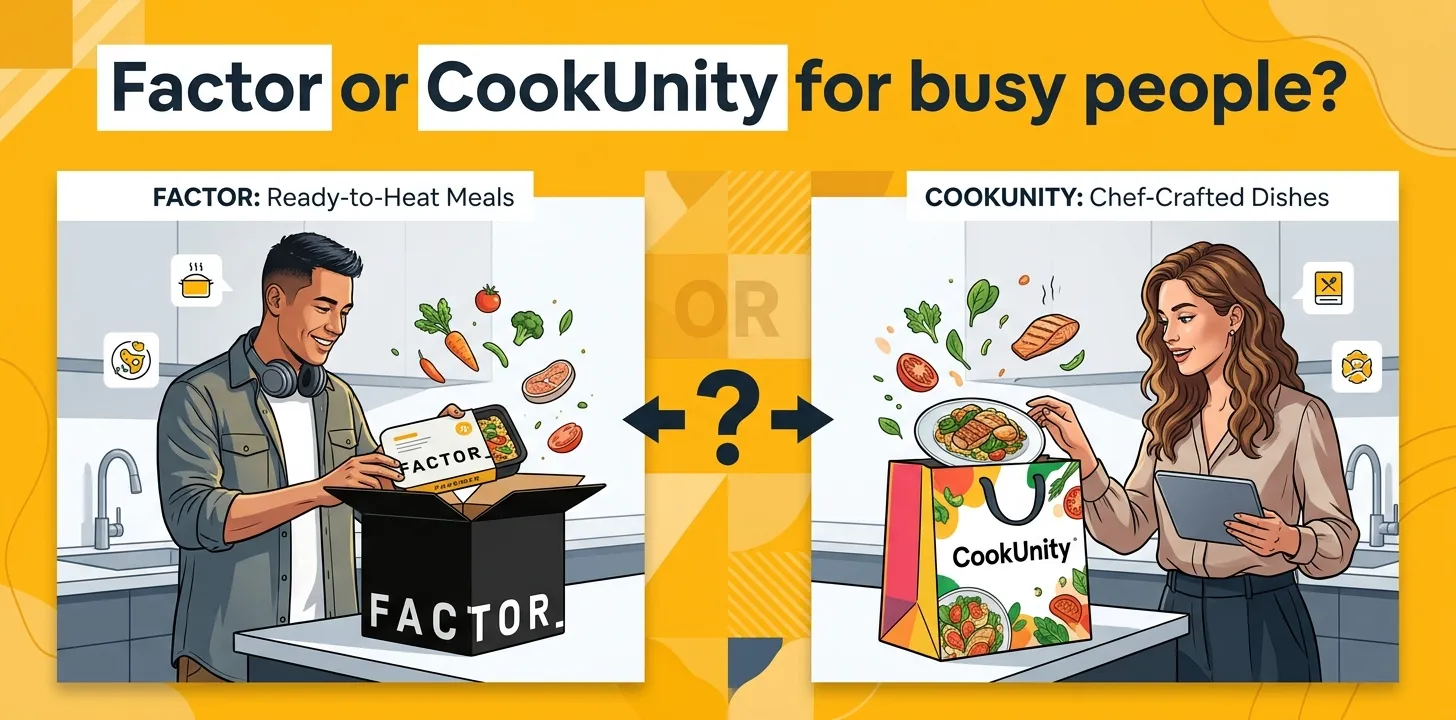
Factor or CookUnity for single adults?
For single adults, CookUnity is usually the better choice if you care most about meal variety and restaurant-style food, while Factor is a stronger pick if you want structured nutrition, high-protein meals, or calorie-focused options. Both deliver fully prepared meals, so the better service depends on how you want to eat during a busy week.
Living alone can make dinner surprisingly difficult. Cooking for one often means buying more ingredients than you need, eating the same leftovers for several days, or ordering takeout when you are too tired to cook. Prepared meal services such as Factor and CookUnity solve that problem in different ways.
Factor vs. CookUnity for One Person
| Feature | Factor | CookUnity |
|---|---|---|
| Best for | Nutrition-focused convenience | Variety and chef-created meals |
| Meal type | Fully prepared | Fully prepared |
| Cooking required | No | No |
| Menu | 100+ dietitian-designed meals and add-ons weekly | Up to 400+ meals |
| Meal plans | Flexible weekly quantities | 4, 6, 8, 12, or 16 meals |
| Nutrition focus | Strong | More flexible |
| Meal style | Balanced, health-focused | Restaurant-style, chef-driven |
| Fresh or frozen | Fresh, never frozen | Fresh and chilled |
| Best for a solo eater | Simple, structured meals | More choice and variety |
Factor says its menu includes 100+ dietitian-designed meals and add-ons each week, with options such as low-carb, vegan and vegetarian, high-protein, and meals under 550 calories. You can also change your meal quantity, skip a week, pause, or cancel.
CookUnity lets customers choose from 4 to 16 meals per week and select individual meals from a large rotating menu. Its meals are designed for one person and arrive chilled, ready to heat and eat.
Why CookUnity May Be Better for Single Adults
More variety without cooking
One of the biggest problems with eating alone is boredom. If you prepare the same few meals every week, it is easy to fall back on pizza, fast food, or takeout.
CookUnity puts more emphasis on variety. The company currently advertises up to 400+ meals and about 100 professional chefs. Menus change weekly, so a solo diner can try different cuisines without buying a long list of ingredients.
That makes CookUnity especially appealing if you think, “I can cook, but I don’t want to eat the same thing all week.”
You choose individual meals
For one person, flexibility matters.
You do not have to build a family-size dinner plan. You can select different dishes for different nights based on what sounds good that week.
For example, a single adult might choose:
- A pasta dish for Monday
- A chicken-based meal for Tuesday
- A vegetarian meal for Wednesday
- A seafood dish for Thursday
That can make meal delivery feel less repetitive.
It fits smaller weekly needs
CookUnity offers plans starting at four meals per week. That can work well if you only want prepared meals for part of the week and prefer to cook, eat out, or make simple meals on other days.
This is an important advantage for a single adult who does not need seven dinners delivered at once.
Why Factor May Be Better for Single Adults
Better if nutrition is your main concern
Factor has a more structured nutrition approach. Its current menu includes categories such as high protein, low carb, vegan and vegetarian, and Calorie Smart meals.
That makes it easier to shop around a specific eating goal instead of simply choosing whatever looks good.
If you are a single adult who wants convenience but also wants to pay attention to calories, protein, or carbohydrates, Factor may feel more straightforward.
Good for people who want simple decisions
Some people do not want a huge menu.
They want to open the refrigerator, grab a meal, heat it, and eat.
Factor is a good fit for that type of routine. Its meals are fully prepared and designed to be ready in about two minutes, according to the company.
For someone with a busy work schedule, that can be more valuable than having hundreds of dishes to choose from.
Clear nutrition information
Factor provides ingredient and nutrition information for its meals, including FDA nutrition information on individual recipes.
That is useful when you want to compare meals before choosing them.
Which Is Easier for One Person?
Both are easy because neither requires normal meal preparation.
The bigger difference is how you choose your food.
Factor is better suited to someone who wants a more structured, nutrition-oriented selection process. CookUnity is better suited to someone who enjoys browsing different dishes and choosing meals based on taste.
For a single adult, that difference can matter more than the basic reheating time.
Which Has Better Food Variety?
CookUnity has the edge for variety.
CookUnity says its platform offers up to 400+ meals, with menus updated weekly and new chefs joining its lineup.
Factor also has a large weekly selection, with 100+ dietitian-designed meals and add-ons according to its current menu information.
So both provide plenty of choices, but CookUnity is more focused on chef-driven variety, while Factor puts more emphasis on nutrition categories.
Which Is Better for a Busy Single Adult?
If your main problem is time, either service can work.
Imagine a single professional who gets home late several nights a week. They do not want to grocery shop, chop vegetables, wash pans, and wait for dinner to cook.
A prepared meal can remove most of that work.
For this person, the decision comes down to what happens after the convenience problem is solved:
- If they want quick meals that fit a specific nutrition style, Factor makes more sense.
- If they want quick meals that feel more varied and restaurant-like, CookUnity is the better match.
What About Cost?
Meal delivery is usually more expensive than cooking a simple meal from groceries, so the real question is whether the convenience is worth the price for you.
CookUnity currently advertises meals starting at $12.59 per meal on its main site, although actual pricing can vary by plan and location.
Factor’s current public pages emphasize weekly plans and promotions rather than presenting one universal price that applies to every customer. Pricing can vary with the number of meals and current offers.
Because promotions change, compare the regular price, shipping, and total weekly charge after the introductory offer ends before deciding.
For a single adult, ordering fewer meals can also be a useful way to control the weekly cost.
Which One Should a Single Adult Choose?
The simplest way to decide is to start with your biggest priority.
| If you care most about… | Better fit |
| More meal variety | CookUnity |
| Chef-created meals | CookUnity |
| Trying different cuisines | CookUnity |
| Nutrition-focused categories | Factor |
| High-protein choices | Factor |
| Calorie-focused meals | Factor |
| A structured food routine | Factor |
| Flexible prepared meals for part of the week | CookUnity |
| Minimal cooking and cleanup | Tie |
Choose CookUnity if…
CookUnity is probably the better match if you:
- Live alone and dislike leftovers
- Want several different meals each week
- Enjoy restaurant-style food
- Like trying new cuisines
- Only need a few prepared meals each week
- Care more about food variety than strict nutrition structure
Choose Factor if…
Factor may be the better choice if you:
- Want high-protein options
- Prefer calorie-conscious meals
- Want clearer nutrition categories
- Like a more structured meal routine
- Have little time to think about dinner
- Want meals that are quick to heat and eat
A Practical Choice for Two Different Single Adults
Consider two hypothetical examples.
Person A works long hours and wants dinner to be as simple as possible. They pay attention to protein and calories and do not care about having dozens of different cuisines. Factor is likely the better fit.
Person B works from home, gets bored with repetitive meals, and wants something closer to restaurant food without ordering takeout. CookUnity is likely the stronger option.
Neither person needs a service designed specifically for families. The important issue is how each service fits their personal eating routine.
One Detail Single Adults Should Not Overlook
Check how many meals you can realistically eat before they reach their use-by dates.
CookUnity says its meals generally have a refrigerated shelf life of about 3–7 days, with a use-by date on the label.
That matters more when you live alone because you may not have another person sharing the meals.
If you order more food than you can reasonably eat, the convenience disappears and the value gets worse.
A better approach is to start with a smaller weekly plan, see how quickly you actually eat the meals, and adjust from there.
Frequently Asked Questions
Is CookUnity or Factor better for one person?
CookUnity is generally the better choice for a single adult who wants more variety and chef-created meals. Factor is a stronger choice for someone who prioritizes structured nutrition, protein, or calorie-focused options.
Does CookUnity make sense for a single person?
Yes. CookUnity states that its meals are generally intended to serve one person, and its plans start at four meals per week.
Is Factor good for busy single adults?
Yes. Factor provides fully prepared meals that can be heated quickly, along with nutrition-focused meal categories. It can be especially convenient when you want dinner without grocery shopping or cooking.
The Bottom Line
For most single adults, CookUnity wins on variety, while Factor wins on structured nutrition. If you want dinner to feel different from night to night, start with CookUnity. If you want a simpler routine built around nutrition goals, Factor may be the better fit.
A practical tip: before subscribing, check the current menu and choose the smallest plan that matches how many prepared meals you actually eat in a normal week. That gives you a better idea of the real value before committing to a larger order.