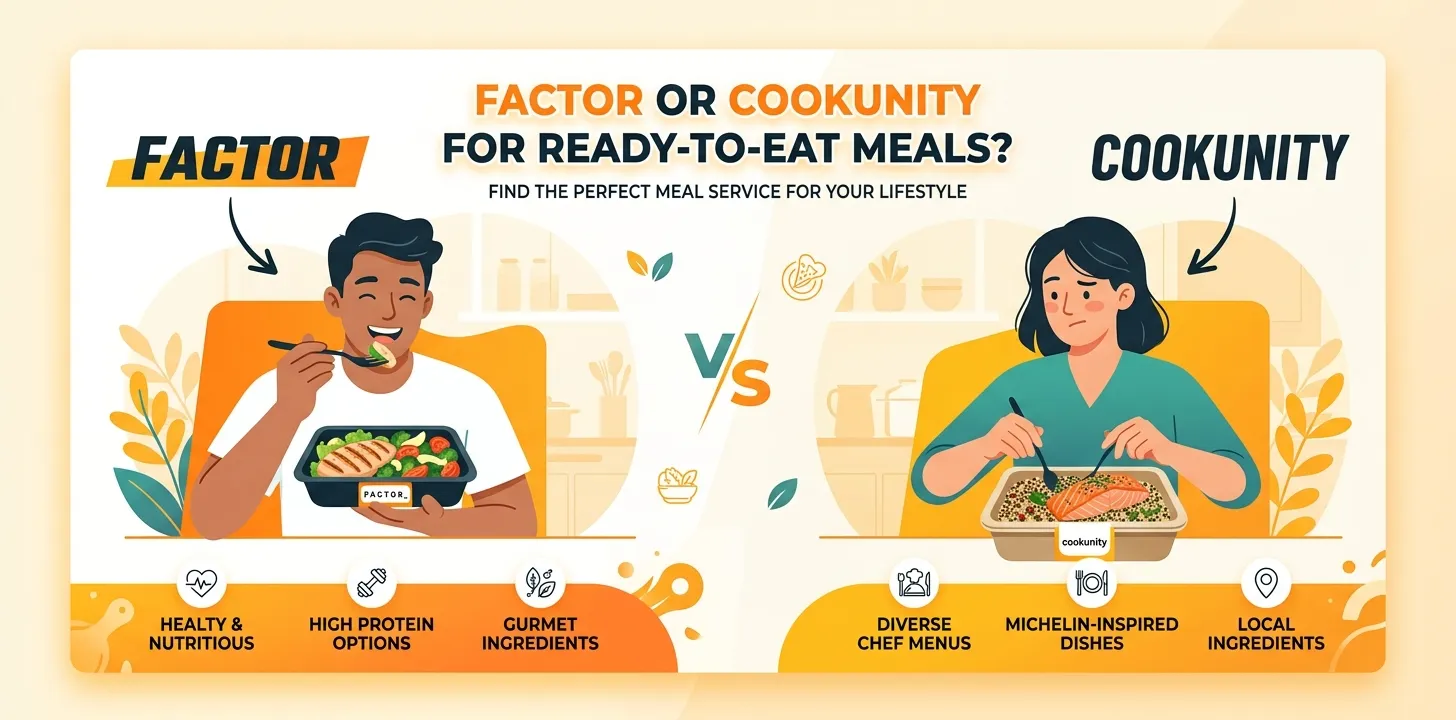
Factor or CookUnity for healthy lunches?
If you want healthy lunches without grocery shopping, cooking, or packing food every morning, both Factor and CookUnity are strong options. But they serve slightly different needs. Factor is the better fit for structured nutrition goals, while CookUnity is usually the better choice for people who want more variety, chef-style meals, and a lunch that feels less repetitive.
Factor or CookUnity for healthy lunches?
For healthy lunches, Factor has an edge if you care most about clear nutrition targets, high-protein meals, calorie-conscious choices, or specific diet filters. Factor currently offers 100+ dietitian-designed meals and categories such as high protein, Calorie Smart, low carb, keto, vegan, and vegetarian. CookUnity is the stronger choice if you care more about meal variety, different cuisines, chef-created recipes, and a restaurant-style lunch.
The right pick depends less on which company is “healthier” and more on what you mean by healthy.
A nutritious lunch might mean:
- Plenty of protein
- A reasonable portion size
- Vegetables and other whole-food ingredients
- Enough calories to keep you satisfied
- A sodium level that fits your needs
- A meal that works with your eating preferences
- Something you will actually enjoy eating regularly
That last point matters. A nutritionally suitable meal does not help much if you get tired of it after a week.
Factor vs. CookUnity for healthy lunches
| Category | Factor | CookUnity |
|---|---|---|
| Main strength | Nutrition-focused prepared meals | Chef-made variety |
| Meal variety | 100+ weekly meals and add-ons | 300+ weekly meals |
| Nutrition filters | Strong | Strong |
| High-protein choices | Excellent | Good |
| Calorie-conscious options | Dedicated Calorie Smart meals | Nutrition information available |
| Cuisine variety | Broad | Especially strong |
| Meal style | Practical, nutrition-focused | More restaurant-style |
| Preparation | Heat and eat | Heat and eat |
| Fresh or frozen | Fresh, never frozen | Fresh and chilled |
| Best for | Structured lunch goals | Variety and flavor |
| Best for picky eaters | Good | Often better |
| Best for repetitive work lunches | Good | Better if variety matters |
Factor says its menu includes more than 100 dietitian-designed meals and add-ons each week, while CookUnity currently promotes more than 300 weekly chef-made meals.
Why Factor may be better for a healthy lunch
Factor’s biggest advantage is that it makes nutrition easier to organize.
Its current lunch offering includes filters for high-protein, Calorie Smart, keto, vegan, vegetarian, and other preferences. Factor says its high-protein meals can provide 50g+ of protein, while its Calorie Smart meals are around 550 calories or less.
That makes Factor useful when you already know what you want from lunch.
For example, a busy office worker might want to open the menu and look specifically for:
- A high-protein lunch
- A meal below a certain calorie level
- A lower-carb option
- A vegetarian meal
- A lunch with specific nutrition numbers
Factor provides nutrition information for each meal, including calories, protein, carbohydrates, fat, fiber, and sodium.
Factor is especially useful for planned lunches
Imagine you work from 9 to 5 and usually end up ordering takeout because you did not plan lunch.
A Factor meal can sit in the refrigerator and become your backup lunch. You do not have to decide where to eat or spend time preparing food. Factor says its meals are ready to heat and eat in about two minutes.
This can make healthy eating easier simply because there are fewer decisions during a busy workday.
Factor also makes lower-sodium choices easier to find
Sodium is worth checking when comparing prepared meals. Factor says sodium varies by recipe and provides nutrition information for each meal. It also offers lower-sodium options with 700 mg of sodium or less per serving.
That does not mean every Factor meal is low in sodium. You still need to check the nutrition label for the specific lunch you choose.
Why CookUnity may be better for a healthy lunch
CookUnity takes a different approach.
Its focus is on chef-created meals and a very large rotating menu. The company currently advertises 300+ weekly meals, more than 100 professional chefs, and options covering diets such as vegetarian, vegan, keto, paleo, and low-carb.
This matters if “healthy” also needs to mean interesting enough to eat five days a week.
You can find lunches inspired by different cuisines instead of eating the same basic chicken-and-vegetable combination repeatedly.
CookUnity’s current healthy and fitness menus include meals such as salmon with roasted vegetables, chicken kale Caesar, pork with asparagus and spinach, and Mediterranean salmon and quinoa.
CookUnity can feel more like a real lunch
This is one of the biggest practical differences between the services.
Factor leans toward predictable, nutrition-focused prepared meals.
CookUnity puts more emphasis on chef-created recipes, sauces, sides, and different culinary styles. That can make a delivered lunch feel closer to something you might order from a restaurant.
Independent customer discussions also commonly mention CookUnity’s variety and restaurant-style feel as reasons for preferring it over Factor, although individual experiences vary.
Which has healthier meals?
Neither service automatically makes every meal healthy.
The individual meal matters more than the brand.
A CookUnity meal can be a great lunch choice, but some dishes may be richer or higher in calories, fat, or sodium than others. CookUnity itself displays nutrition information on its meals, and its healthy meal pages include examples ranging from lighter meals to dishes with substantially more calories.
Factor has the same basic issue. Its menu includes nutrition-focused categories, but that does not mean every meal is appropriate for every nutrition goal. Factor’s own nutrition information shows that sodium, calories, and other nutrients vary by recipe.
So instead of asking, “Which company is healthier?” ask:
“Which service makes it easier for me to choose the type of lunch I need?”
What to check before choosing a lunch
A quick nutrition check can help you compare two meals from either service.
Look at:
- Protein — Does the meal provide enough protein for your needs?
- Fiber — Meals with vegetables, beans, whole grains, or other fiber-rich foods may be more satisfying.
- Sodium — Check the actual number rather than assuming a meal is low sodium.
- Calories — Choose a portion that makes sense for your overall day.
- Vegetables and other whole foods — Look beyond the protein and sauce.
- Saturated fat and added sugar — These can vary widely between recipes.
- Ingredients and allergens — Especially important if you have food allergies or avoid certain ingredients.
You do not need to find a perfect nutritional score. The goal is to choose lunches that fit your overall eating pattern.
Factor vs. CookUnity for high-protein lunches
Factor is the easier pick if high protein is your main lunch priority.
Factor specifically promotes high-protein meals and says some provide 50g or more of protein per serving. Its menu also lets you combine high-protein choices with other nutrition categories.
CookUnity also has plenty of protein-rich meals, including chicken, salmon, beef, seafood, and plant-based options. Its menu can work well for someone who wants protein without sacrificing variety.
The difference is that Factor makes the nutrition goal more central to the shopping experience, while CookUnity makes food variety and chef-created meals a bigger part of the experience.
Factor vs. CookUnity for calorie-conscious lunches
Factor has the clearer advantage if you want a dedicated calorie-conscious category.
Its Calorie Smart meals are designed around approximately 550 calories or less per meal, and nutrition details are shown before ordering.
CookUnity also provides calorie and nutrition information, so you can choose meals based on your own target. Its current menu includes both lighter meals and much more calorie-dense options.
That makes Factor easier if you want to filter for calorie-conscious lunches rather than manually compare a large number of dishes.
One caution: a lower-calorie meal is not automatically a better meal. Your lunch should still provide enough food and nutrients for your needs.
Factor vs. CookUnity for lunch variety
CookUnity wins on variety.
CookUnity currently advertises more than 300 weekly meals and a large group of chefs creating dishes across different cuisines.
Factor also has a large menu, with 100+ dietitian-designed meals and add-ons each week.
Both give you choices, but CookUnity is especially appealing if you like trying different cuisines and do not want your weekday lunch to feel like meal prep.
This is a practical health issue, too. If variety helps you stick with home-delivered lunches instead of falling back on fast food or takeout, the broader menu may be valuable.
Which is better for office lunches?
Both can work well for office lunches because the meals arrive prepared and only need reheating.
Factor’s lunch service is specifically designed around ready-to-heat midday meals and says its lunches arrive fresh and never frozen.
CookUnity also offers prepared lunches that can be heated quickly. Its lunch service currently promotes fresh meals that are ready in minutes.
If your office has a microwave and refrigerator, either can be convenient.
If you share an office kitchen, however, think about more than nutrition. Strong smells, heating time, storage space, and the amount of food you bring to work can affect which meals are practical.
Which is more affordable?
Prices change based on the plan, meal count, location, shipping, promotions, and selected meals, so it is better to compare the full checkout cost rather than relying on a headline price.
CookUnity currently lists meals starting at $12.59 before its promotional discount, and its site says delivery is generally a flat $9.99 or $11.99 depending on ZIP code.
Factor also charges shipping, and its promotions can change. Its current website is advertising introductory offers, but promotional pricing should not be treated as the normal long-term cost.
When comparing lunch costs, calculate:
meal price + shipping + taxes + premium meal charges − applicable discounts
Then divide that total by the number of meals in the box.
That gives you a much better idea of your real cost per lunch.
Freshness and storage matter for weekday lunches
Both services deliver prepared meals that are designed to be stored in the refrigerator.
Factor says its meals are fresh rather than frozen.
CookUnity says its meals are delivered fresh and chilled. It also says its meals generally have a refrigerated shelf life of about 3–7 days, with a “use by” date on the label.
That means your delivery day matters.
If you order five lunches for the workweek, check the dates on arrival and plan to eat meals according to the package instructions rather than assuming every meal will last the same amount of time.
Two practical lunch scenarios
If you want predictable nutrition
Suppose you work at a desk and want five simple lunches each week. You care about protein and calories more than trying a new cuisine every day.
Factor is probably the better fit.
Its nutrition-focused filters make it easier to build a box around those goals.
If you get bored with meal prep
Now imagine you enjoy foods from different cuisines and usually stop bringing lunch because the same meals become boring.
CookUnity may be the better fit.
Its large rotating menu and chef-created recipes give you more ways to change your lunches from week to week.
and choose lunches that fit your own needs.
FAQs
Is Factor or CookUnity better for weight management?
Factor has a clearer calorie-conscious system, including Calorie Smart meals around 550 calories or less. CookUnity also provides nutrition information, so you can select meals based on calories and other nutrients. Neither service should be treated as a guaranteed weight-loss program.
Is CookUnity healthier than Factor?
Not across the board. Both services offer meals with different calorie, protein, fat, carbohydrate, fiber, and sodium levels, so the healthiest choice depends on the specific meal and your dietary needs.
Which is better for healthy work lunches?
Factor is a strong choice when you want easy nutrition filters and predictable meal planning. CookUnity may be better if you care more about variety and want chef-created lunches that feel less repetitive. Both offer fresh, prepared meals that can be ready in minutes.
The best choice is the one that fits your normal workday. If nutrition targets come first, start with Factor; if variety keeps you eating better at home or work, start with CookUnity. Before ordering a full week, compare a few actual meals side by side for protein, fiber, sodium, calories, ingredients, and price. That small check can tell you more than the brand name alone.
The bottom line
For most people choosing specifically between the two, Factor is the better pick for nutrition-focused lunches, while CookUnity is the better pick for variety and meal enjoyment.
Choose Factor if you want:
- High-protein options
- Calorie-conscious choices
- Clear diet categories
- A structured weekly lunch routine
- Easy nutrition filtering
Choose CookUnity if you want:
- A much larger rotating menu
- More chef-driven recipes
- More international flavors
- Restaurant-style meals
- More variety throughout the workweek
Neither service makes every meal automatically healthy. The smarter approach is to use the nutrition information for each recipe