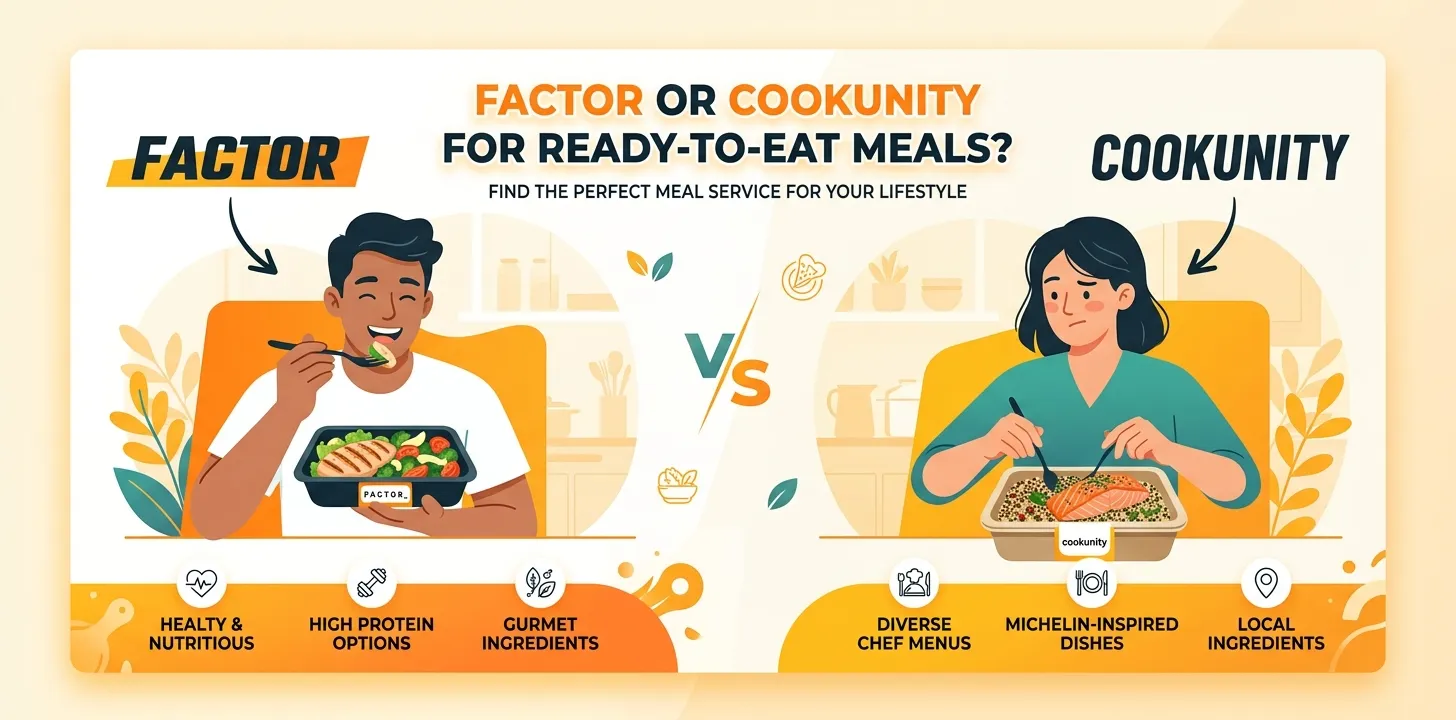
Factor or CookUnity for fitness meals?
If your main goal is convenient meals that make it easier to eat enough protein and stay consistent, Factor is usually the better fit for fitness-focused eating. Its High Protein meals provide 30g or more of protein per serving, with some reaching 50g+. CookUnity is a strong choice if you want more chef-driven variety while still having high-protein options.
The two services look similar at first. Both deliver prepared meals that you can heat in minutes. But they are built around different priorities.
Factor puts more emphasis on structured nutrition, protein, calories, and diet-focused meal plans. CookUnity puts more emphasis on chef-created meals, variety, and flavor while still offering fitness-friendly choices.
So which one makes more sense for someone who works out regularly?
Factor vs. CookUnity for fitness meals at a glance
| Fitness factor | Factor | CookUnity |
|---|---|---|
| Best fit | Structured fitness nutrition | Variety-focused fitness eating |
| High-protein option | 30g+ protein per meal | Protein Boost meals generally 25–30g+ |
| Some higher-protein meals | Yes, some 50g+ | Available depending on meal |
| Calories shown | Yes | Yes |
| Protein, carbs, and fat shown | Yes | Yes |
| Meal prep required | No | No |
| Fresh or frozen | Fresh, never frozen | Fresh, never frozen |
| Diet-focused choices | Strong | Broad |
| Menu variety | Large | Very large |
| Main strength | Consistent nutrition | Chef variety and flavor |
Factor says its High Protein meals contain at least 30g of protein per serving, with some meals offering 50g or more. CookUnity’s Protein Boost meals generally provide 25–30g or more per serving and display full macro information.
That difference matters if protein is one of the main numbers you track.
Why Factor may be better for fitness-focused eating
Factor has a clear advantage if you want your meal service to do more of the nutrition planning for you.
Its fitness meal options include High Protein, Calorie Smart, Keto, Vegan + Veggie, and Chef’s Choice. The High Protein plan is specifically designed around meals with at least 30g of protein per serving.
You can also see the nutrition information before ordering. That makes it easier to compare meals based on protein, calories, carbohydrates, and fat instead of choosing only by the meal name.
Factor makes macro tracking simpler
Imagine you are trying to build a week of lunches and dinners around a consistent protein intake.
With Factor, you can look through the menu and quickly identify meals that meet your protein preference. You do not have to cook chicken, measure rice, or prepare several containers on Sunday.
That does not mean Factor automatically creates a complete fitness diet. Your total nutrition still depends on everything else you eat during the day.
But the ready-made format can remove one common problem: skipping a planned meal because you ran out of time to cook.
Factor is also useful for calorie-conscious meals
Factor offers a Calorie Smart option with meals around 550 calories or less, according to its current fitness meal information.
For someone who wants both protein and a defined calorie range, this can make meal selection easier.
The key is to look at the actual nutrition label for each meal rather than assuming every High Protein meal has the same calorie or carbohydrate profile.
Why CookUnity may be better for fitness meals
CookUnity takes a different approach.
Its fitness-focused menu includes Protein Boost meals, and the company says these meals typically contain 25–30g or more of protein per serving. Nutrition information includes calories, protein, carbohydrates, and fat.
The biggest reason to choose CookUnity is variety.
CookUnity works with many chefs and offers a large rotating menu. Its current fitness pages highlight hundreds of menu options and meals from numerous chefs.
CookUnity can make healthy eating feel less repetitive
This matters more than it sounds.
A fitness meal plan can become boring if every meal feels like chicken, rice, and vegetables. CookUnity gives you more room to change cuisines and flavors while still looking for meals that fit your nutrition needs.
For example, a person could choose a salmon dish one night, a chicken-based bowl another night, and a different cuisine later in the week.
The important step is to check the nutrition label rather than assuming a meal is high in protein simply because it contains meat or fish.
CookUnity gives you more control over food preferences
CookUnity lets users set nutrition preferences such as high-protein or low-carb and choose preferred protein types and cuisines. You can also mark ingredients and flavors you want to avoid.
There is one limitation: CookUnity says ingredient avoidance is not a 100% exclusion guarantee. People with serious food allergies should read the individual ingredient information carefully and follow the company’s allergy guidance.
Which has better protein for workouts?
Factor has the clearer edge if protein per meal is your main concern.
Factor’s High Protein meals start at 30g of protein per serving, and some provide 50g or more. CookUnity’s Protein Boost meals generally start around 25–30g or more.
That does not mean every Factor meal has more protein than every CookUnity meal. Individual dishes vary, so compare the nutrition labels for the meals you actually plan to order.
For fitness eating, look beyond protein alone. A useful meal may also need enough calories, carbohydrates, fats, and other nutrients to fit your overall eating pattern.
Which is better before or after a workout?
Neither service is automatically the best choice for every workout.
For a meal around training, the better option is the one whose calories, protein, carbohydrates, fat, and portion size fit your needs.
Factor can be easier when you want predictable nutrition information and higher-protein choices. CookUnity can work well when you want similar convenience but prefer more variety.
For example, someone doing a hard evening workout may want a meal that includes both protein and carbohydrates rather than choosing a meal based on protein alone.
A person with a lighter training schedule may have different needs.
The meal service should support your overall eating pattern, not replace it.
Which service has better meal variety?
CookUnity wins if variety is your top priority.
CookUnity’s model centers on meals created by different chefs, with a large rotating selection across cuisines. Its current sports nutrition materials describe more than 300 rotating menu options.
Factor also has a large rotating menu. Its fitness page currently describes more than 100 weekly options and add-ons.
The difference is more about the experience:
- Factor: more nutrition-focused selection
- CookUnity: more chef and cuisine variety
- Factor: easier to build a routine around specific nutrition goals
- CookUnity: easier to keep meals interesting
If you get tired of eating similar meals, CookUnity may be easier to stick with.
Which is easier for meal prep?
Both are extremely convenient because you are not starting with raw ingredients.
Factor meals arrive prepared and are designed to be heated and eaten in minutes. Factor says its meals are fresh, never frozen, and can be ready in about two minutes.
CookUnity also delivers fresh, chilled prepared meals that require no traditional cooking. Its meals come with heating instructions.
So there is no major winner here.
The real advantage is that both can replace part of a traditional meal-prep routine.
Instead of spending several hours shopping, cooking, portioning, and cleaning, you can select prepared meals and heat them when needed.
Which is better for muscle-building goals?
If your priority is making protein intake easier, Factor gets the edge.
Its High Protein plan is directly built around meals containing at least 30g of protein, with some meals offering 50g or more.
CookUnity can still work well. Its Protein Boost selection gives you meals specifically marked for higher protein, and you can review the full nutrition information before ordering.
But neither service should be viewed as a complete muscle-building program.
Training, total food intake, protein across the day, sleep, and your overall eating pattern all matter. A meal delivery service mainly solves the convenience problem.
Which is better for weight-loss-focused fitness meals?
This depends on what you need from the service.
Factor has a useful advantage because its current fitness options include both High Protein and Calorie Smart meals. The Calorie Smart meals are listed at about 550 calories or less.
CookUnity also has calorie-conscious options. Its current menu describes Calorie Smart meals as containing less than 600 calories, along with other filters such as low-carb and low-sodium.
For either service, do not assume that a meal labeled “healthy” or “fitness” will automatically fit your personal calorie needs.
Check the actual nutrition information for each dish.
Which has better dietary flexibility?
This is a closer matchup.
Factor offers several structured eating patterns, including High Protein, Calorie Smart, Keto, and Vegan + Veggie.
CookUnity offers a broad set of dietary filters and preferences, including high-protein, low-carb, vegetarian, vegan, gluten-free, and dairy-free options.
CookUnity may appeal more if your dietary preferences are about both nutrition and cuisine.
Factor may be easier if you want a more straightforward fitness-oriented selection process.
What about freshness and storage?
Both services use refrigerated prepared meals rather than frozen meals.
Factor says its meals are never frozen and can stay fresh in the refrigerator for up to seven days.
CookUnity says its meals have a refrigerated shelf life of about three to seven days because it does not use artificial or chemical preservatives. Each meal has a use-by date.
This creates one practical difference in how you plan your week.
If you order several meals, check the dates when the box arrives and eat the meals according to their labels rather than assuming every meal will last the same amount of time.
Factor vs. CookUnity: the better choice for different fitness needs
| If your main goal is… | Better choice |
| 30g+ protein as a baseline | Factor |
| Higher-protein fitness meals | Factor |
| Easier calorie-focused selection | Factor |
| Macro tracking | Factor |
| Maximum meal variety | CookUnity |
| More chef-created choices | CookUnity |
| More cuisines and flavors | CookUnity |
| Fitness meals that do not feel repetitive | CookUnity |
| Simple nutrition-focused routine | Factor |
| Flavor and variety first | CookUnity |
Two realistic ways to choose
Example 1: You lift several days a week
Suppose you train four or five days a week and want prepared lunches with a predictable protein level.
Factor makes more sense because its High Protein meals are clearly positioned around 30g+ of protein, and some meals provide 50g or more.
You can still eat other foods during the day and adjust your meals based on your overall nutrition needs.
Example 2: You work out but hate repetitive meal prep
Now imagine you exercise regularly but quickly get tired of eating the same few meals.
CookUnity may be the better fit. Its large rotating menu and chef-based model give you more ways to change flavors while still selecting Protein Boost or other nutrition-focused meals.
In this situation, variety may help you stay consistent with prepared meals over time.
Is Factor or CookUnity better for fitness meals?
Choose Factor if your first priority is structured nutrition, especially protein and calorie tracking. Choose CookUnity if your first priority is variety, chef-created food, and staying interested in your meals. Both can work for active people because both offer prepared meals with visible nutrition information and high-protein choices.
The best choice is not simply the service with the highest protein number.
It is the one that makes it easier for you to eat meals that fit your needs consistently.
What to check before ordering
Before choosing either service, look at the actual weekly menu instead of relying only on the plan name.
Check:
- Protein per serving
- Total calories
- Carbohydrates
- Fat
- Sodium
- Ingredient list
- Portion size
- Number of meals you will actually eat
- Refrigerated use-by dates
- Delivery coverage for your ZIP code
- Current price and shipping terms
This is especially useful because meal nutrition can vary widely from one dish to another.
Frequently asked questions
Is Factor better than CookUnity for high-protein meals?
Factor has the clearer high-protein positioning, with High Protein meals containing at least 30g of protein per serving and some offering 50g or more. CookUnity also has Protein Boost meals that generally provide 25–30g or more per serving.
Can CookUnity meals be good for people who work out?
Yes. CookUnity offers Protein Boost meals and fitness-focused options, with nutrition information available for individual dishes. You can also filter meals based on preferences such as high protein and low carb.
Should I choose Factor or CookUnity for meal prep?
Choose Factor if your main goal is a simple nutrition-focused routine with clear high-protein choices. Choose CookUnity if you are more likely to stick with meal prep when you have a wider range of flavors and chef-created dishes.
The bottom line
For the keyword Factor or CookUnity for fitness meals, Factor is the stronger pick for people who want a more structured, protein-focused meal routine. CookUnity is the better match for people who want fitness-friendly meals without giving up chef variety and different cuisines.
Expert tip: Before subscribing, build a sample week from each menu. Pick five or six meals you would genuinely eat and compare their protein, calories, carbs, fat, and price. That simple test is more useful than choosing based on the brand name alone.